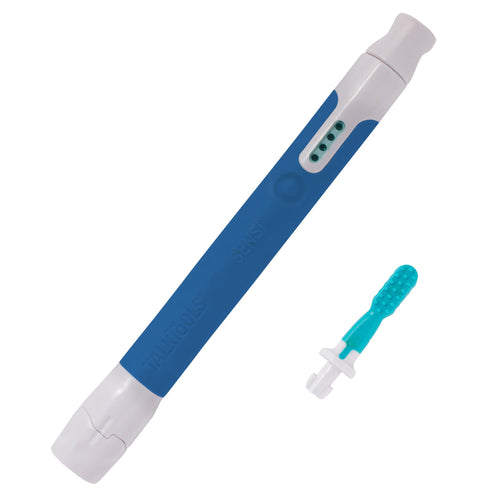
Texture-Graded Oral Toolkit — Pink
Free shipping on orders $50+. Taxes calculated at checkout.
- Chosen and explained by a pediatric occupational therapist
- Free shipping on orders over $50
- Secure checkout · Return policy
Not sure this fits your child? Book a 20-minute call with a pediatric OT →
About this tool
In OT and feeding sessions, this is one of the most common patterns I see: a child who gags on certain textures, refuses toothbrushing, or fights every attempt to get near their mouth or teeth — not because they're being difficult, but because their mouth is genuinely oversensitive to touch and texture.
That's oral tactile defensiveness, and it doesn't resolve by pushing through it. It resolves through slow, graded exposure — introducing texture and pressure in small, predictable steps the nervous system can actually tolerate and adapt to.
A graded desensitization toolkit an OT actually recommends
If your child gags easily, refuses toothbrushing, avoids certain food textures, or resists anything touching their lips, teeth, or the inside of their mouth, they may have oral tactile defensiveness — a mouth that reads normal touch and texture as far more intense than it is. This toolkit's 7 graded texture levels let you introduce oral input step by step, building tolerance safely instead of forcing exposure your child's nervous system isn't ready for. The same graded resistance also gives oral sensory seekers — kids who chew on shirts, pencils, or hands — a safe, purposeful outlet, so this one toolkit supports both ends of the oral sensory spectrum.
Who it helps
- Kids with oral tactile defensiveness — gagging, toothbrushing refusal, resistance to touch near the mouth
- Picky eaters whose food refusals are texture-driven rather than preference-driven
- Kids who chew on non-food objects (collars, sleeves, pencils, hair) seeking oral input
- Kids who avoid new textures or chew on everything
- Kids working on articulation, jaw stability, or feeding skills in speech/OT therapy
- Ages 3+ (see safety note below)
Sensory systems supported
Oral-tactile discrimination and desensitization, oral-proprioceptive input, jaw grading and stability.
How to use it
- For desensitization: start at your child's current tolerance level and move to the next texture only once they're consistently comfortable — never force progression
- For oral seeking: offer during homework or screen time to keep the mouth "busy" and hands free
- Use the 7 graded texture levels to build tolerance or jaw strength progressively, as guided by your OT or SLP
- Rotate with a chew tool for on-the-go oral input between sessions
Why an OT recommends it
Whether a child is oral-defensive or oral-seeking, the mouth's response to touch runs through the same nervous system pathway — it's just calibrated differently. Graded, predictable texture exposure is the clinical standard for reducing oral defensiveness over time, and that same graded resistance gives a seeking nervous system clear, calming proprioceptive feedback. This toolkit's 7 levels let you meet your child wherever they currently are and progress at their pace, rather than a one-size-fits-all tool.
Safety note
Always supervise oral-motor tool use with young children. Introduce new texture levels one at a time, and never move to a more intense level before your child is consistently comfortable with the current one. Not a substitute for professional feeding/speech therapy — pairs well with it, and desensitization protocols are best guided by your child's OT or SLP.
FAQ
Is this the same as a chew necklace? No — chew necklaces are for casual oral seeking; this toolkit is a clinical-grade tool for graded oral desensitization and jaw exercise, often used alongside feeding/speech therapy.
My child gags on toothbrushing — will this help? Many families use graded oral tools like this one as part of a desensitization routine before toothbrushing or dental visits. Ask your feeding therapist or OT how to build it into your child's specific plan.
What age is this appropriate for? Most OTs introduce graded oral tools around age 3+, once a child can follow basic safety direction. Always confirm with your therapist for younger children.
Can this help with picky eating? Oral tactile tolerance and jaw strength both affect a child's willingness and ability to manage textured foods — ask your feeding therapist how to incorporate this toolkit into that work.
Is it easy to clean? Yes — dishwasher-safe silicone pieces; always dry fully before storage.
Is this related to ARFID or picky eating? Oral tactile defensiveness is one contributing factor some families and clinicians look at when a child's picky eating is severe, texture-driven, or rises to the level of ARFID (Avoidant/Restrictive Food Intake Disorder) — though ARFID itself is a clinical diagnosis, not something this toolkit treats on its own. If food refusal is affecting your child's nutrition, growth, or daily life, read our clinical breakdown of why ARFID research is behind and what it's missing about the nervous system, and consider a feeding-focused OT evaluation.
In practice, this is what we typically see once a family builds a consistent graded routine: less gagging and resistance around the mouth, and — for seekers — a safe place for the chewing to go instead of shirt collars and pencils.
Every product at Sensory Therapy Place is selected through the lens of pediatric occupational therapy by our founder, Earl Mamaril, MS, OTR/L.
Related: Pairs well with our Sensory Compression Vests for kids who need both oral and deep-pressure input, or our Texture Graded Oral Desensitization Tool for on-the-go use. Not sure what your child needs? Take our Sensory Quiz.
Related reading: Why Does My Child Chew Everything? An OT's Guide to Oral Sensory Seeking · Why ARFID Research Is Behind — And What It's Missing About the Nervous System
This may not be the right fit if…
- Your child bites hard enough to damage chew tools
- You haven't talked with an OT or SLP about oral tools
- Your child refuses anything near their mouth. Start with hands-only play.
More for mouth, chewing & mealtime
Other tools a pediatric OT might pair with this one.